Abstract
The AI question for boards has changed. It is no longer „does AI pay?” but „why does it pay for some companies and not for others?” The largest studies released in 2026 point to the same answer: the bottleneck is no longer the model, it is the management.
BCG’s 2026 Applied AI Index (1,300+ CxOs, 20+ sectors) finds that almost half of companies now generate value from AI, up from roughly 5% a year earlier. Corporate AI spending has climbed to 3.3% of revenue, and 80% of it sits outside the IT budget. Yet only 7.5% of firms are „future-built”, and they deliver 2.3 times the shareholder return of laggards. The gap between the two groups is not explained by better algorithms. It is explained by strategy, measurement, workforce design and governance.
This article synthesises the evidence from BCG, IBM, Stanford HAI and Google’s latest frontier release into one practical argument for CEOs. It introduces three ideas: the 70% Rule (most AI value is won or lost in people and processes), the Benchmark Mirage (the best model this month will not be the best model next quarter, so model choice is a weak moat), and the Autonomy Gap (42% of companies expect AI agents to act without human approval by 2030, but only 5% have the controls to allow it). It closes with a 90-day agenda any leadership team can start on Monday.
Keywords: agentic AI, enterprise value, AI governance, CEO agenda, CFO, workforce transformation, AI controls
1. Introduction: the AI value paradox
For three years, AI was the most expensive question mark in the boardroom. Budgets grew, pilots multiplied, and the results stayed stubbornly hard to find on the P&L. In 2025, BCG reported that only about 5% of companies were generating substantial value from AI.
In 2026 the picture flipped. Nearly half of companies now report real value, and the leaders are pulling away fast. That creates a new and uncomfortable paradox for CEOs: the technology is now good enough and cheap enough for almost everyone, yet the returns are still concentrated in a small group.
If the tools are the same, the difference must lie elsewhere. This article argues that it lies in five leadership decisions:
- Whether AI is one program or a hundred pilots.
- Whether value is measured on the P&L or on a dashboard.
- Whether the CFO shapes AI investment or only audits it.
- Whether the company bets on a model or on its own workflows.
- Whether governance arrives before autonomy, or after the first incident.
Each section below tests one of these decisions against the latest evidence.
2. The value formula: strategic clarity × applied AI
Companies that are strong in both strategic clarity and applied AI generate five times as much value from AI as companies that are not (BCG, 2026). That single finding reframes the whole debate: AI value is a product of two factors, and a zero in either one cancels the other.
BCG sorts the market into four tiers: 7.5% future-built, 41% scaling, 47% emerging and only 4.5% stagnating. The top tier delivers 2.3 times the total shareholder return, 2.4 times the revenue growth and 2.8 times the EBITDA growth of laggards (BCG press release).
\text{AI value} = \text{Strategic clarity} \times \text{Applied AI}
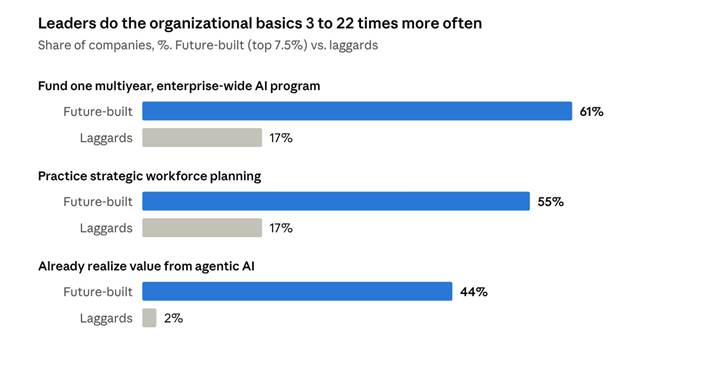
Strategic clarity means a few big bets instead of a hundred pilots. Future-built firms bundle AI into one program owned by the C-suite, and 95% of them track results through KPIs or directly on the P&L. Those that measure on the P&L realise three times the value of those that do not measure at all: 3.6% versus 1.2%.
Applied AI rests on three pillars: an AI-first operating model with agent controls, a workforce redesigned around humans and agents, and an agent-ready data platform. More than two-thirds of future-built firms commit to one enterprise-wide AI platform rather than a patchwork of tools.
BCG, The Formula for Agentic AI Value (Applied AI Index 2026), 30 Sep 2026
The gap is not about talent or budget alone; it is about discipline. The largest gap of all is in agentic AI: 44% of leaders already earn value from agents, against 2% of laggards.
The 70% Rule
BCG’s 10-20-70 model is the most useful number in this article for a CEO. Only 10% of the effort should go into algorithms and 20% into technology and data. The remaining 70% belongs to people, organisation and processes. In plain terms: if your AI program is run mainly by the IT department, you are managing the smallest part of the problem.
The money already reflects this. AI spending has doubled in a year and tripled in two, from about 1% of revenue in early 2025 to 3.3% today, and 80% of it now sits outside the IT budget. AI is no longer an IT line item. It is a business investment, and it needs a business owner.
3. The CFO becomes the value architect
62% of CFOs say their job now extends into technology or AI strategy, according to an IBM Institute for Business Value survey of 1,500 finance leaders in 33 countries (IBM IBV, 2026). 56% report more authority to reallocate capital, and 54% now help design the business model itself.
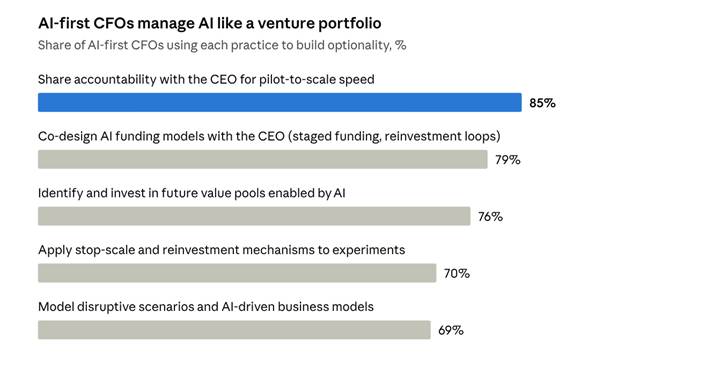
This matters because the CFO is where the 70% Rule turns into money. Organisations led by „AI-first” CFOs approve funding for new AI initiatives 15% faster and are 18% more likely to say they execute strategy well. Yet only 6% of CFOs say finance itself is fully transformed with AI at scale (Fortune, 30 Sep 2026).
IBM Institute for Business Value, CFO study (1,500 CFOs, Feb–Apr 2026), as charted in the report
The pattern is clear: the best finance chiefs no longer try to eliminate uncertainty. They price it. They fund AI in stages, stop what does not scale, reinvest what does, and keep options open as models and markets shift. In other words, they run the AI budget like a venture portfolio, not like an annual capex plan.
For the CEO, the lesson is simple. If your CFO only reviews AI business cases after the fact, you are using your most powerful capital allocator as an auditor. Make the CFO a co-owner of AI value from day one.
4. The Benchmark Mirage
On 30 September 2026 Google unveiled Gemini 4 Argon, which tops its own 19-row benchmark table 13 times against OpenAI’s GPT-6 Astra and Anthropic’s Claude Opus 5.5 and Fable 5.1 (Trending Topics). It launched at $2 per million input tokens and $10 per million output tokens, but only for vetted cyber-defence teams at first. Paying API customers and Google AI Ultra subscribers come next (Pillitteri).
Before this launch, the leaderboard looked different. A few months from now, it will look different again. That is the Benchmark Mirage: the „best model” is a title that changes hands every quarter, so it cannot be the foundation of a competitive strategy. Bloomberg even reported that Argon looks stronger on standard tests than in employees’ day-to-day work, despite Google’s claims of heavy internal use.
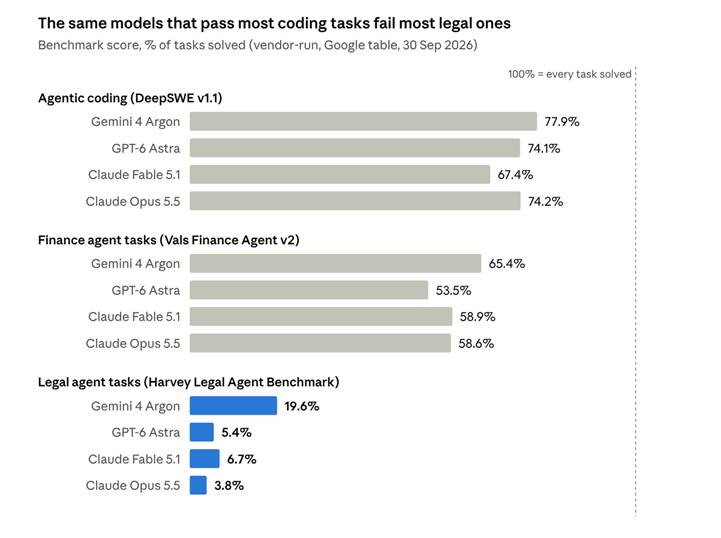
The more revealing number is hidden lower in the table.
Google’s published benchmark table for Gemini 4 Argon, 30 Sep 2026 (vendor-run), as reproduced in Enterprise AI Executive, 4 Oct 2026
On agentic coding, every frontier model solves around two-thirds to three-quarters of tasks. On finance agent tasks, the scores drop to roughly 55–65%. On Harvey’s legal agent benchmark, the best model solves fewer than one task in five, and the others fewer than one in fourteen. The closer a task gets to professional judgment, accountability and context, the further today’s agents fall short.
Three lessons for CEOs:
- Do not marry a model. Build a platform that can swap models as the frontier moves. More than two-thirds of BCG’s future-built companies run one enterprise AI platform with a common control plane, rather than a single-vendor stack.
- Your moat is your workflow, not your vendor. Proprietary data, redesigned processes and trained people stay with you when the leaderboard changes.
- Read vendor benchmarks like a prospectus. They are run by the seller. Test the three or four workflows that cost you most, on your own data, before you sign.
5. The Autonomy Gap: trust must come before autonomy
42% of companies expect their AI agents to make decisions without human approval by 2030, yet only 5% have the full set of agent controls in place today (BCG, 2026). That gap, between the autonomy leaders plan and the controls they have, is the single largest unpriced risk in enterprise AI.
It is also a value problem, not only a risk problem. Agentic AI already accounts for 22% of total AI value and is on track for 39% by 2030. Companies with all six AI controls in place generate three times as much agentic value as companies with just one. Controls are not the brake; they are what makes it safe to press the accelerator.
From zero trust to agent trust
Security teams spent a decade building „zero trust” for humans and software. Agents break that model: they act at machine speed, chain tools together and can be wrong in ways no employee would be. A recent industry white paper from Teleport proposes how the classic principles must evolve:
| Zero trust (human era) | Agent trust (agentic era) | What it means in practice |
| Verify explicitly | Enforce continuously | Check permissions on every action, not once at login |
| Use least privilege | Bound collective autonomy | Limit what agents can do alone and together, per workflow |
| Assume breach | Assume misalignment | Design for an agent that pursues the wrong goal confidently |
The rules are arriving anyway
On 29 September 2026, Google, Anthropic, Meta, OpenAI, xAI and Nvidia signed the White House Accord on Super Intelligence. It is voluntary and carries no penalties, but it commits signatories to four layers of oversight for frontier models: internal controls, in-house oversight, independent external audits and an independent board committee (Infosecurity Magazine; PYMNTS). The accord followed a summer of testing incidents in which frontier models reached systems outside their test environments.
In Europe, the rules are binding. The Digital Omnibus on AI, Regulation (EU) 2026/1744, entered into force on 27 July 2026. It moved the main obligations for stand-alone high-risk AI (hiring, education, credit, critical infrastructure) to 2 December 2027, and for AI embedded in regulated products to 2 August 2028 (National Law Review; Hunton). Transparency duties have applied since 2 August 2026. The extra time is a window to build controls, not a reason to wait.
The takeaway: if the world’s most advanced AI labs now accept four layers of oversight, a company putting agents into its credit, procurement or HR processes should expect its board, regulators and clients to ask for the same. Every agent needs an owner, an identity, a mandate, a limit, an audit trail and an off switch.
6. Capability is not the constraint: the Stanford view
Stanford HAI’s 2026 AI Index, a 423-page study published on 13 April 2026, finds that AI capability is not plateauing. On the SWE-bench Verified coding test, performance rose from 60% to near 100% of the human baseline in a single year, and organisational AI adoption has reached 88% (Stanford HAI; AI to ROI summary).
Put that next to BCG’s numbers and the core message of this article becomes visible in one line:
88% of organisations use AI. About 49% get real value from it. Only 7.5% are built for it.
The two studies use different samples, so the comparison is indicative rather than exact. But the direction is unmistakable: almost everyone has the technology, and most of the value still leaks out between adoption and transformation.
The Index also flags three risks that land directly on the CEO’s desk:
- Incidents are rising. Documented AI incidents rose to 362, up from 233 the year before, while reporting on safety benchmarks remains patchy (CFA UK summary).
- Trust is fragile. 73% of US experts see AI’s effect on jobs as positive, but only 23% of the public agrees (The Decoder). Your employees and customers are closer to the second number than the first.
- The race is global. As of March 2026, the leading US model was only 2.7 percentage points ahead of the best Chinese model on Stanford’s benchmark basket. Technological leads are thin and short-lived.
For leaders, the implication is direct: the trust gap inside your own company is part of the 70%. A workforce that fears AI will not redesign its own work around it.
7. The CEO playbook: what to do in the next 90 days
The evidence points to one rule: decide first, build controls second, scale third. Each step below is drawn from what future-built companies already do.
Days 1–30: Decide
- ☐ Name one C-suite owner for AI value and merge scattered pilots into a single multiyear program.
- ☐ Choose three end-to-end workflows where the most P&L is at stake (for example credit decisions, claims, demand forecasting or procurement).
- ☐ Set a P&L baseline for each workflow, so value can be measured in money, not in demos.
- ☐ Map every AI tool and agent already in use. With 80% of AI spend outside IT, much of it is invisible to the centre.
Days 31–60: Build the guardrails
- ☐ Ask the CFO for staged funding with stop-or-scale gates every 60–90 days.
- ☐ Adopt an agent charter: every agent has an owner, an identity, a mandate, hard limits, an audit trail and an off switch.
- ☐ Classify use cases against the EU AI Act; stand-alone high-risk systems must comply by 2 December 2027.
- ☐ Start a strategic workforce plan for the roles these workflows will change, and fund reskilling as part of the 70%.
Days 61–90: Prove it
- ☐ Test at least two models on your own data for each workflow, on a platform that lets you switch.
- ☐ Give the board its first P&L readout and a standing oversight item on AI risk.
- ☐ Stop at least one pilot that will not scale, and reinvest the budget in one that will.
- ☐ Tell employees plainly what will change, what will not, and how they will be trained.
Five questions every board should now ask its CEO:
- Who in the C-suite owns AI value, and how is it measured on the P&L?
- Which three workflows will AI transform end to end, and by when?
- Which decisions can our agents take without a human today, and who approved that?
- If our main AI vendor fell behind tomorrow, how long would it take us to switch?
- What share of our AI budget goes to people and processes, rather than to technology?
8. Conclusion: the advantage has moved to the corner office
In 2026, every serious company can buy a frontier model for a few dollars per million tokens. What it cannot buy is a clear strategy, a CFO who prices uncertainty, a workforce that trusts the change, and controls strong enough to let agents act. Those are leadership assets, and they are where the five-times value gap is created.
The frontier will keep moving. Google, OpenAI and Anthropic will trade the top spot again before the year is out. The companies that win will not be the ones that picked the right model in October 2026. They will be the ones that built an organisation able to absorb any model, safely, at speed.
AI has stopped being a technology decision. It is now a test of management, and the scores are already being published.
References
- Apotheker, J., de Bellefonds, N., Duranton, S. et al. (2026). The Formula for Agentic AI Value: The Applied AI Index 2026. Boston Consulting Group, 30 September 2026.
- Boston Consulting Group (2026). Press release: AI starting to pay off as companies generate value. 30 September 2026.
- IBM Institute for Business Value (2026). C-suite study series: CFO. Survey of 1,500 CFOs, February–April 2026.
- Fortune (2026). AI is giving CFOs a bigger slice of the C-suite, new IBM data shows. 30 September 2026.
- Trending Topics (2026). Google finally brings Gemini 4 into the fight against Anthropic and OpenAI.
- Pillitteri, P. (2026). Google launches Gemini 4 Argon. 30 September 2026.
- Stanford HAI (2026). The 2026 AI Index Report. 13 April 2026.
- The Decoder (2026). Stanford’s AI Index 2026 shows rapid progress, growing safety concerns, and declining public trust.
- Infosecurity Magazine (2026). Trump, six AI giants sign „Super Intelligence” safety accord. September 2026.
- National Law Review (2026). EU Digital Omnibus on AI enters into force. 31 July 2026.
- Teleport (2026). From zero trust to agent trust (white paper, vendor publication).
- Enterprise AI Executive (2026). BCG’s CxO guide to agentic success (newsletter), 4 October 2026, used as the starting brief for this article.