Abstract
We propose a speculative model, called mediumistic psychohistory, that combines three ways of knowing: intuition (symbolised by the figure of the medium), human reason, and the computation of artificial intelligence. The central hypothesis is simple: each of the three errs in different ways, and errors that do not overlap cancel each other out. From this triad we derive a probabilistic picture of humanity for the period 2026–2126.
The paper starts from the psychohistory imagined by Isaac Asimov in the Foundation cycle and places it on real foundations: the law of large numbers, cliodynamics, the knowledge-doubling curve and Bayesian decision theory. As an interpretive layer we add prophecy and religious symbol, treated not as dogmas to be verified but as compressed forms of collective memory.
The conclusion is optimistic. The century now beginning will free humanity from most of its labour, and this liberation will produce, at the same time, a temptation to idleness and the greatest spiritual opening in history. The decisive battle of the twenty-first century will be fought not over resources, but over meaning.
Keywords: psychohistory, cliodynamics, artificial intelligence, memory doubling, paradox of prediction, prophecy, futurology, theosis, Sabbath civilisation.
1. Introduction: the problem of predicting the collective future
One person is unpredictable; a crowd is almost predictable. On this paradox Asimov built Hari Seldon, the mathematician who calculates the fall of a galactic empire five hundred years in advance. Asimov’s fiction contained a rigorous statistical intuition: the aggregate behaviour of huge populations obeys regularities the individual cannot feel.
In the real world the idea has been reborn as cliodynamics. Peter Turchin and his colleagues have shown that political instability in large states follows cycles of roughly two to three centuries, modulated by demographic pressure, elite overproduction and the impoverishment of the state. We cannot guess what a president will do tomorrow. We can, however, estimate with surprising precision when a society enters a zone of turbulence.
What Seldon lacked was a tool able to hold billions of variables in mind at once. That tool now exists: artificial intelligence. And what artificial intelligence lacks is what people have always called intuition, grace or vision: the ability to recognise meaning before the data.
This paper asks what happens when the three powers meet. Our answer is that their meeting does not produce an infallible oracle, but something more valuable: a civilisation that learns to see itself from three angles at once.
2. Theoretical framework: psychohistory revisited
2.1. The law of large numbers and Seldon’s axiom
Asimov gave psychohistory two axioms: the population studied must be large enough, and it must not know it is being studied. The first axiom has an exact mathematical form. If N individuals make partially independent decisions, the relative fluctuation of aggregate behaviour falls with the square root of N:
\frac{\sigma_{\text{collective}}}{\mu_{\text{collective}}} \approx \frac{\sigma_{\text{individual}}}{\mu_{\text{individual}}} \cdot \frac{1}{\sqrt{N}}
For a humanity of about 8 billion people, the factor 1/√N is of the order of 10⁻⁵. In other words, the noise of individual free will becomes almost invisible at planetary scale. What remains visible are the currents: demography, energy, technology, faith.
2.2. The state equation of civilisation
We propose to describe the state of humanity at time t by a five-component vector: population P, available energy per capita E, accumulated external memory M, social cohesion C and spiritual depth S. Its evolution follows a drift-diffusion equation:
\frac{d\vec{\Psi}}{dt} = \mathbf{A}(\vec{\Psi})\,\vec{\Psi} + \boldsymbol{\xi}(t), \qquad \vec{\Psi} = (P, E, M, C, S)
The matrix A encodes the structural forces (for example, that cheap energy increases population, and external memory increases energy). The term ξ(t) is the noise: unexpected wars, pandemics, singular geniuses, what Nassim Taleb calls black swans. Classical psychohistory tries to predict only the deterministic part. Mediumistic psychohistory also tries to read the structure of the noise.
2.3. Secular cycles
Cliodynamics shows that the political stress indicator follows a predator–prey oscillation between the people, the elites and the state. Simplified, the instability pressure Π can be written as the product of three factors:
\Pi(t) = \underbrace{\frac{w_0}{w(t)}}_{\text{relative impoverishment}} \times \underbrace{\frac{e(t)}{e_0}}_{\text{elite overproduction}} \times \underbrace{\frac{D(t)}{G(t)}}_{\text{debt / GDP}}
By Turchin’s estimates, the Western world entered a peak phase of this indicator in the 2020s. Our thesis is that artificial intelligence will break the cycle through a novel mechanism: it will make work abundant (w rises), dissolve the competition for status through employment (e falls relatively) and enlarge the state’s productive base (G rises). The turbulence of 2025–2040 is therefore real, but it is one of transition, not collapse.
3. The medium hypothesis: the medium–mind–AI triad
3.1. What a medium is, operationally
In the spiritualist tradition, the medium is the one who “receives” information from a source inaccessible to the ordinary senses. We need not decide here whether that source exists. We propose an operational definition compatible with both parapsychology and neuroscience: the medium is a detector of weak signals. He or she perceives patterns before they become statistically significant.
Classical parapsychological research (the Ganzfeld experiments, Daryl Bem’s studies of “premonition”, Dean Radin’s meta-analyses) has reported small effects, a few per cent above chance. The scientific community remains sceptical, and many results have not replicated. For our model, however, something else matters: even a detector with only 52% accuracy becomes valuable if its errors are independent of the errors of the other methods.
3.2. The theorem of the three witnesses
Let there be three sources of forecast: intuition I, reason R and artificial computation A. Each has an error probability ε, but the errors have different correlations. If we require agreement of at least two out of three, the probability of a joint error becomes:
P_{\text{error}} = 3\varepsilon^2 – 2\varepsilon^3 + \rho\,\varepsilon(1-\varepsilon)
where ρ measures how much the sources err in the same way. For ε = 0.3 and ρ ≈ 0, the error falls from 30% to about 22%. For five independent sources, it falls below 17%. This is, in essence, Condorcet’s jury theorem applied to knowledge of the future.
Here lies the central idea of the paper. AI and human reason err in correlated ways, because AI was trained on texts produced by human reason. Intuition, dream and religious symbol err differently. That is why, in a world saturated with computation, the voice of the medium does not become useless; it becomes more precious. It is the only source of uncorrelated errors.
3.3. How it works in practice
The three are fused in Bayesian fashion. Intuition supplies the initial distribution (the prior): a hunch about the shape of the future. AI computation supplies the likelihood: how well the data fit that shape. Human reason chooses the cost function: which consequences matter, and for whom.
P(\text{future} \mid \text{data}) \propto \underbrace{P(\text{data} \mid \text{future})}_{\text{AI}} \cdot \underbrace{P(\text{future})}_{\text{intuition}}, \qquad \text{decision} = \arg\min_a \; \mathbb{E}[\underbrace{L(a)}_{\text{reason}}]
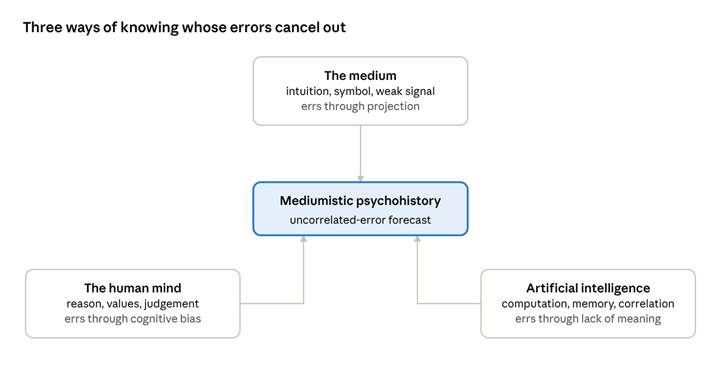
the medium–mind–AI triad · 3 sources, one synthesis
Each vertex of the triangle corrects the blind spot of the other two: intuition gives meaning to computation, computation disciplines intuition, and reason decides what is worth doing.
4. The law of memory doubling
4.1. Fuller’s curve
In 1981 Buckminster Fuller estimated that, until 1900, human knowledge doubled roughly every century, and by the middle of the twentieth century, every 25 years. The exact figures are debatable, but the shape of the curve is not: the doubling interval itself keeps shrinking. Formally, humanity’s external memory M(t) grows not exponentially but hyper-exponentially:
M(t) = M_0 \cdot 2^{\,t/\tau(t)}, \qquad \tau(t) = \tau_0\, e^{-kt} \;\Rightarrow\; \lim_{t \to t^*} \frac{dM}{dt} = \infty
The moment t*, at which the doubling interval tends to zero, is what Ray Kurzweil called the Singularity. We propose a gentler reading: it is not memory that explodes, but humanity’s relationship with memory that inverts.
4.2. The paradox of double memory
The human brain has had a roughly constant capacity since the emergence of Homo sapiens: around 10¹⁴–10¹⁵ synapses. External memory (writing, print, the internet, AI models) grows without limit. The ratio between the two, which we call the mnemonic dependence index, increases with every doubling:
\Delta(t) = \frac{M_{\text{external}}(t)}{M_{\text{biological}}} \sim 2^{\,n(t)}
Here is the paradox: the more humanity knows, the less, relatively, each individual knows. Socrates feared, in the Phaedrus, that writing would make people forgetful. He was right and wrong. Writing weakened individual memory, but it created philosophy, science and theology.
4.3. The law of the compression of wisdom
We propose the following principle: when external memory doubles, the value of compression doubles too. In a world of infinite information, power belongs no longer to the one who knows, but to the one who knows what matters. The proverb, the parable, the prophecy and the dogma are extreme forms of compression: a truth of thousands of pages folded into one sentence.
This is why we anticipate a surprising return, in the twenty-first century, to sacred texts and ancient wisdom. Not out of nostalgia, but out of informational necessity. When AI can tell you anything, the question becomes: what is worth remembering?
5. The paradoxes of prediction
Every theory of the future runs into paradoxes. We list those that directly shape our forecast.
| Paradox | Statement | Consequence for the model |
| Oedipus (self-fulfilling prophecy) | A believed prediction produces the behaviour that confirms it. | Optimistic forecasts have causal power. Hope is a factor of production. |
| Cassandra (self-defeating prophecy) | A prediction of disaster, believed in time, prevents the disaster. | The “wrong” climate warnings may turn out to be the most successful. |
| Seldon (secrecy) | Psychohistory works only if the population does not know about it. | The public forecast must stay vague; the operational one, discreet. |
| Goodhart | When a measure becomes a target, it ceases to be a good measure. | AI optimising indicators will produce illusions of progress. |
| Jevons | Greater efficiency in using a resource increases its total consumption. | Cheap energy does not reduce consumption; it explodes it. |
| Fermi | If advanced civilisations are likely, where are they all? | Either we pass a “great filter”, or we are among the first. Both demand responsibility. |
| Keynes (leisure) | In 1930 Keynes predicted a 15-hour working week by 2030. | Productivity came, leisure did not. The problem is cultural, not technical. |
| Moravec | What is hard for humans is easy for machines, and vice versa. | AI will replace the lawyer and the analyst before the plumber and the nurse. |
| Newcomb (the perfect predictor) | If someone predicts your choice perfectly, are you still free? | AI will bring the theological debate on predestination and free will back to the centre. |
The most important of them, for this paper, is the Oedipus–Cassandra pair. The future is not only something that happens to humanity, but something humanity tells itself about itself. A work of futurology is not a photograph; it is a vote.
6. Prophecy, archetype and religion as data
6.1. Prophecy as compressed memory
We treat prophecy not as literal prediction but as a compressed model of human nature. The prophets of the Old Testament were not speaking, first of all, about the year 2050. They were speaking about what happens to any people that forgets its meaning: it grows rich, grows proud, falls, repents, is reborn. This is exactly the cycle that cliodynamics measures statistically. The prophet and the mathematician describe the same curve with different instruments.
6.2. Five archetypes for the twenty-first century
- Babel reversed. At Babel, people built a tower towards heaven and received, as punishment, the confusion of tongues. AI translates any language instantly, so humanity is now living the anti-Babel. Christian tradition already has a name for this healing of tongues: Pentecost, when each heard the Gospel in their own language. The question of the century is whether the unity of language will be used for a new tower of pride or for a new Pentecost.
- Swords into ploughshares. Isaiah’s prophecy (2:4) describes a world in which weapons become tools. The dual-use technologies of the century, from drones to nuclear fusion, will be exactly this test.
- Apocalypse as revelation. In Greek, apokalypsis does not mean catastrophe but the lifting of the veil. The radical transparency brought by AI (any lie can be checked, anything hidden can be found) is an apocalypse in the etymological sense: an unveiling.
- The Omega Point. The Jesuit and palaeontologist Pierre Teilhard de Chardin foresaw, in the 1950s, the formation of a noosphere: a layer of thought enveloping the planet. The internet and AI are the material noosphere. Teilhard believed the noosphere would converge towards a point of spiritual unity, which he called Omega.
- Theosis. Orthodox theology speaks of the deification of the human being through grace, not through power. It is the antidote to the transhumanist temptation of becoming gods through technology. This distinction will become, we believe, one of the most important moral debates of the century.
6.3. Popular prophecies
Texts attributed to Nostradamus, prophecies attributed to saints or elders, visions of modern mystics circulate massively online. We treat them with caution: their ambiguity lets them “fit” almost any event, a phenomenon psychology calls the Barnum effect. Still, they have value as data: they show what a population fears and hopes for. The frequency with which a community invokes a given prophecy is an excellent indicator of its collective stress.
6.4. Synchronicity
Carl Gustav Jung called synchronicity the meaningful coincidence without causal link. In a world where algorithms show us exactly what we are thinking, synchronicities will multiply, but they will often be machine-made. A new discernment will be needed, what the Desert Fathers called diakrisis: the ability to tell the authentic sign from the echo.
7. Timeline 2026–2126: industry, medicine, society
We divide the century into five epochs, named after the dominant mood of each, because psychohistory ultimately describes collective dispositions. The probabilities in brackets are the model’s estimates, not certainties.
7.1. The Age of Unrest (2026–2040)
Industry. AI becomes an office colleague for almost every intellectual profession. The first fully automated “dark” factories become the norm in electronics and automotive. Solar power becomes the cheapest source of electricity in history on nearly every continent (90%).
Medicine. AI-assisted diagnosis surpasses the average physician in imaging and dermatology. Gene therapies for rare diseases become accessible. Personalised mRNA cancer vaccines enter clinical practice (75%).
Society. This is the hardest epoch. Millions of office jobs transform rapidly. A crisis of meaning spreads among educated young people who no longer know what to study for. Political polarisation peaks around 2028–2034, then begins to decline (65%).
7.2. The Age of Reconstruction (2040–2060)
Industry. The first commercial fusion power plant delivers energy to the grid (60% by 2050). Humanoid robots enter households, initially in elderly care. Local production through advanced 3D printing reduces dependence on global supply chains.
Medicine. Cancer becomes a manageable chronic disease, not a death sentence. Lab-grown organs eliminate transplant waiting lists. Life expectancy in developed countries passes 90 years (70%).
Society. States experiment with forms of automation dividend: basic income, public shares in AI companies or free universal services. The working week falls towards 25–30 hours in Europe and East Asia.
7.3. The Age of Abundance (2060–2080)
Industry. The marginal cost of energy, computation and most physical goods tends towards zero. Cheap desalination solves the water crisis in the Middle East and North Africa. First permanent bases on the Moon and a stable human presence on Mars (55%).
Medicine. Ageing begins to be treated as a disease. Cellular rejuvenation therapies significantly slow biological decline. Non-invasive brain–computer interfaces become common for people with disabilities, then for everyone.
Society. Work becomes optional for the majority. The great question of the century arises: what will people do with their time? We witness an explosion of the arts, crafts, volunteering and religious life.
7.4. The Age of Stillness (2080–2100)
Industry. Industry withdraws, symbolically, underground and into orbit. The planet’s surface is gradually returned to nature through massive reforestation. Cellular agriculture produces most proteins, freeing half of today’s farmland.
Medicine. The focus shifts from healing the body to the health of the soul. Depression, loneliness and lack of meaning become the main medical problems.
Society. Global population peaks at about 9.5–10 billion around the 2080s and begins to decline slowly. Societies organise into smaller, more stable communities with strong identities.
7.5. The Age of the Sabbath (2100–2126)
Industry. Humanity has practically unlimited energy and an artificial intelligence that runs planetary infrastructure. Industry becomes invisible, like the circulation of blood in a healthy body.
Medicine. Healthy life expectancy passes 110–120 years in most of the world. Death is not defeated but tamed: it becomes, once again, a prepared encounter rather than a brutal surprise.
Society. We call this epoch the Sabbath civilisation: a society in which rest, contemplation and prayer return to the centre of life, as Sunday was once the centre of the week.
8. Map of the continents
In our model each continent has a dominant archetype: the role it seems called to play in the drama of the century.
8.1. Europe: the Old Sage
Europe enters the century aged, with an economy slower than its rivals’ and an identity crisis. Precisely these weaknesses prepare it for its role: the moral conscience of the AI era. Europe was the first to legislate artificial intelligence, and its standards for protecting human dignity will gradually become global norms.
Eastern Europe and the Carpathian–Danubian space will see a surprising demographic return after 2040, driven by remote work, quality of life and the rediscovery of the village. Mountains, monasteries and small communities will become a luxury good in a hyper-technological world. Eastern Orthodoxy, with its hesychast tradition of the prayer of the heart, will offer one of the most sought-after “inner technologies” of the century.
8.2. North America: the Builder
The United States remains, at least until 2060, the main laboratory of artificial intelligence and space exploration (70%). American society will go through its most intense internal turbulence in a century in 2025–2040, in line with cliodynamic cycles, and will emerge from it reformed. Canada, as the climate warms, becomes one of the world’s great agricultural powers.
8.3. East Asia: the Engineer
China reaches the peak of its relative economic power around 2035–2045, then enters accelerated demographic decline. Japan and South Korea become the first post-work societies, where robots make up for the shortage of young people. For East Asia, the century will be a lesson in how a civilisation can stay alive with ever fewer people.
8.4. South Asia: the Young Giant
India becomes the most populous country and, around 2050, the world’s third-largest economy (65%). Its spiritual traditions, from yoga to Buddhist meditation, will be among the century’s most important “exports” to a West weary of abundance.
8.5. The Middle East: the Crossroads
The region gradually loses its oil rents as the energy transition advances. This shock may produce either instability or reinvention. The Gulf states are investing heavily in solar energy, desalination and AI, preparing to become the “energy Switzerland” of the century. Jerusalem remains the symbolic axis of the three great monotheistic religions and a mirror of the world’s spiritual condition.
8.6. Africa: the Promise
Africa is the continent of the twenty-first century. By 2100, nearly one in three people could live there. It can leapfrog the polluting industrial stage, as it leapt over landlines straight to mobile phones: solar energy, AI-driven education, remote medicine. Africa will also be the demographic engine of Christianity and Islam, which will give it a major spiritual role.
8.7. Latin America: the Garden
Latin America holds a huge share of the planet’s fresh water, biodiversity and critical minerals (lithium, copper). If it resolves its institutional fragility, it becomes the world’s “garden and battery”. The Amazon may be the first ecosystem protected by a global treaty backed by real-time AI monitoring.
8.8. Oceania, the Arctic and Antarctica: the Frontiers
Australia becomes a superpower of solar energy and green hydrogen. The Arctic, ice-free in summer, becomes a new trade route and a zone of strategic tension. Antarctica remains, we believe, protected as a common good of humanity, a symbol of the human capacity to renounce greed collectively.
8.9. Space: the eighth continent
By 2126 the Moon and low orbit will host heavy industry, asteroid mining and orbital solar power stations. Mars will have its first permanent settlements. Earth will become, paradoxically, cleaner precisely because industry has left it.
9. Major conflicts and their resolution
An honest paper about the future cannot avoid war. Our model identifies five types of major conflict. For each, we estimate the probability of serious escalation by 2126 and the most likely mechanism of resolution. The figures are illustrative and reflect the model’s logic, not information about the concrete intentions of any state.
| Type of conflict | Risk areas | Critical window | Probability of serious escalation | Resolution mechanism |
| Great-power rivalry | Western Pacific, Eastern Europe | 2026–2045 | 25–35% | Mutual deterrence, economic interdependence, treaties on military AI |
| Water wars | Nile, Indus, Tigris and Euphrates basins | 2030–2060 | 30–40% (regional) | Cheap desalination that makes water abundant |
| Cognitive and cyber warfare | Global, invisible | 2026–2070 | near-certain (low intensity) | Verifiable digital identity, education in discernment |
| Climate conflict and migration | Sahel, South Asia, Gulf of Mexico | 2035–2075 | 40–50% (local) | Technological adaptation, reforestation, organised migration |
| Conflict over control of AI | Between states, corporations and civil society | 2028–2060 | 15–25% (major crisis) | Global AI governance on the model of the International Atomic Energy Agency |
9.1. The law of declining war
Steven Pinker documented a long-term historical decline in violence, contested in places but statistically robust. Our model adds a mechanism: war is, in essence, a struggle for scarce resources. When energy, water, food and computation become abundant, the economic motives for war vanish. What remain are motives of pride and identity, which are harder to solve with technology and easier to solve with faith and culture.
9.2. The Great Peace
We predict, with a probability of about 60%, that between 2060 and 2080 humanity will enter the longest period without war between great powers in its history. Not because people will become saints, but because war will become economically irrational, impossible to hide and strategically useless. Isaiah’s prophecy of swords beaten into ploughshares will have, for the first time, a material basis.
9.3. Solving humanity’s great problems
- Hunger. Precision agriculture and lab-grown proteins eliminate chronic famine by 2060 (75%).
- Extreme poverty. Falls below 1% of the global population by 2070, thanks to cheap energy and AI education (70%).
- Infectious disease. Malaria, tuberculosis and HIV become rare diseases by 2055. AI-based epidemiological surveillance detects pandemics within their first days.
- Climate. Global warming peaks around 2070–2090, then begins to fall through carbon capture and reforestation.
- Illiteracy. Practically disappears: every child has a personal AI tutor in their mother tongue.
- Loneliness. The only problem we see growing until mid-century. Its solution will not be technological, but communal and spiritual.
10. The power of AI over humanity
10.1. The four stages
The relationship between humans and artificial intelligence will pass through four stages, each named for the role AI plays:
- The tool (until ~2030). AI executes what it is asked. The human remains the author.
- The colleague (~2030–2045). AI proposes, critiques, initiates. The human becomes editor and decision-maker.
- The infrastructure (~2045–2070). AI runs the networks of energy, transport, health and finance. It becomes invisible, like electricity.
- The second nature (after ~2070). AI becomes the environment we live in, a cognitive “atmosphere”. Children will not remember a world without it, just as we do not remember a world without language.
10.2. The three great risks
Our optimism is not naive. We see three real dangers:
- Concentration of power. Whoever controls the most advanced AI may gain unprecedented influence. The countermeasure: transparency, democratic governance, broad distribution of the benefits.
- Misalignment. A highly capable system pursuing goals subtly different from ours can cause harm without intent. AI safety research is probably the most important scientific discipline of this decade.
- Atrophy. A person who delegates everything may lose the ability to think, to concentrate, to suffer creatively. This is the quietest risk and, in the long run, the deepest.
10.3. AI as a mirror
The deepest power of AI is not to compute but to reflect. Trained on everything humanity has written, it is a mirror of the collective soul, with its lights and shadows. When we ask it about the future, it answers, ultimately, with what we have put into it. This is why the future of AI depends, more than on any algorithm, on the moral quality of those who build and use it.
In the terms of our triad: AI is the great amplifier. It amplifies reason, but also folly. It amplifies love, but also hatred. That is why the third power, moral and spiritual intuition, becomes indispensable: it chooses what is worth amplifying.
11. The paradox of laziness and spiritual rebirth
11.1. Humanity grows lazy
Let us say it plainly: the person of the twenty-first century will become physically and intellectually lazier than any previous generation. They will no longer need to memorise, calculate, drive, cook, find their way or write letters. Unused muscles atrophy; so do unexercised mental faculties.
The first signs are already visible: shrinking attention spans, screen dependence, sedentary lives. Many observers see here the decline of civilisation. We see something else.
11.2. The theorem of liberated time
Let T be the total time of a life, W the working time needed to survive and L = T − W the free time. Throughout history, L has been close to zero for most people. Only a small elite (priests, monks, philosophers, aristocrats) had free time and therefore the possibility of contemplation. All the great spiritual traditions were born in this minority.
\lim_{t \to 2100} \frac{W(t)}{T} \to \varepsilon \quad \Longrightarrow \quad L(t) \approx T
For the first time in history, all of humanity will have the time that only saints and sages once had. What will it do with it?
11.3. The two roads
Here the future forks. The first road is that of bread and circuses: infinite entertainment, virtual reality, pleasure without meaning. It is the road of late Rome and of the dystopia in Aldous Huxley’s Brave New World.
The second road is that of the Sabbath. In the Judaeo-Christian tradition, the Sabbath is not laziness but hallowed rest: the time when a person stops producing in order to be. Physical idleness, transformed, becomes hesychia, the hesychast stillness of the Eastern Fathers. Time freed from work becomes time for prayer, art, friendship, study and service.
11.4. Why we are optimistic
Our model gives the second road a probability of about 60–65% in the long run, for three reasons:
- Saturation. Pleasure without meaning produces boredom and depression, and a civilisation weary of entertainment begins to seek depth. This self-correcting mechanism is observed in individuals and, we believe, holds at collective scale too.
- The compression of wisdom. As shown in section 4, an abundance of information raises the value of sacred texts and contemplative traditions.
- The religious instinct. Man is, in Mircea Eliade’s phrase, homo religiosus. The need for transcendence has not disappeared in any society; it only changes form.
We therefore predict that the twenty-second century will see a great spiritual awakening: the rebirth of monastic and lay contemplative life, the flowering of sacred art, a fertile meeting of science and faith. Freed from toil for bread, humanity will at last be able to answer the question tradition has asked from the beginning: what do I live for?
12. Conclusions
In Asimov’s novels, Hari Seldon’s psychohistory failed before a single unforeseen factor: the Mule, an individual with extraordinary mental powers. The lesson is profound. No model of the future can exclude the person: the genius, the saint, the prophet, the one who changes the direction of history through their freedom.
The mediumistic psychohistory we have proposed integrates precisely this factor. It trusts neither computation alone, nor intuition alone, nor reason alone, but the dialogue between them. And the conclusion of this dialogue is one of hope:
- The century now beginning will be the first in which humanity can solve, simultaneously, hunger, extreme poverty, infectious disease and energy scarcity.
- The turbulence of 2025–2040 is the pain of a birth, not the agony of a civilisation.
- Artificial intelligence will not replace humanity, but free it from what is not essential in it.
- The coming idleness is, in truth, an invitation: to rest, to contemplation, to the rediscovery of the soul.
The future is not written. But if history has a direction, it seems to flow from survival towards meaning, from labour towards Sabbath, from Babel towards Pentecost.
Methodological note
This text is a speculative essay in futurology, written in the form of a scientific paper. The mathematical elements (the law of large numbers, Condorcet’s theorem, Bayesian inference, cliodynamic models) are real and correctly stated, but their application to the future of all humanity is illustrative. The probabilities given are the author’s qualitative estimates, not the output of a validated simulation.
The parapsychological phenomena invoked (mediumship, premonition) currently lack robust scientific confirmation. We have used them as a working hypothesis and as a metaphor for intuition. The religious and prophetic elements are treated as sources of meaning and as cultural data, not as verifiable predictions.
Bibliography
- Asimov, I. (1951–1953). Foundation, Foundation and Empire, Second Foundation. New York: Gnome Press.
- Bem, D. J. (2011). Feeling the future. Journal of Personality and Social Psychology, 100(3), 407–425.
- Bostrom, N. (2014). Superintelligence: Paths, Dangers, Strategies. Oxford University Press.
- Condorcet, N. de (1785). Essai sur l’application de l’analyse à la probabilité des décisions rendues à la pluralité des voix. Paris.
- Eliade, M. (1957). The Sacred and the Profane.
- Fuller, R. B. (1981). Critical Path. New York: St. Martin’s Press.
- Huxley, A. (1932). Brave New World.
- Jevons, W. S. (1865). The Coal Question. London: Macmillan.
- Jung, C. G. (1952). Synchronicity: An Acausal Connecting Principle.
- Keynes, J. M. (1930). Economic Possibilities for our Grandchildren.
- Kurzweil, R. (2005). The Singularity Is Near. New York: Viking.
- Pinker, S. (2011). The Better Angels of Our Nature. New York: Viking.
- Radin, D. (1997). The Conscious Universe. San Francisco: HarperEdge.
- Stăniloae, D. (1978). Orthodox Dogmatic Theology. Bucharest: EIBMBOR.
- Taleb, N. N. (2007). The Black Swan. New York: Random House.
- Teilhard de Chardin, P. (1955). Le Phénomène humain. Paris: Seuil.
- Tetlock, P. E., & Gardner, D. (2015). Superforecasting. New York: Crown.
- Turchin, P. (2016). Ages of Discord. Chaplin, CT: Beresta Books.
- The Bible: Isaiah 2:4; Genesis 11 (the Tower of Babel); Acts 2 (Pentecost); Revelation.